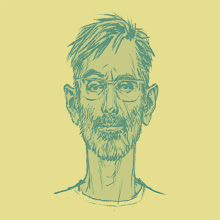
Sketch
Started a class tonight over at the community college – a lower-level requirement for a certificate I'm after. Tonight, actually, was
very low-level. We'll see how things develop. Might turn out to be, in the end, a good weekly excuse to get in a little drawing.
There's a great little A6-size sketchbook that stays in my brief-bag – so is pretty much with me wherever business of one kind or another takes me – but that hasn't seen use in about four years. Tonight it came out toward end of class – perhaps to find that it's got a future after all. Can't deny feeling some shame whenever I happen to notice it, & recall that two-thirds of its sheets are blank. (Its inaugural use, I observe, is dated 1/19/2000, for crying out loud!)

It's seen much better drawing than this, sad to have to say. (E.g., the first two examples
here.) But then it's also seen a lot worse.
I'll point out here that there's a new page of small drawings of people – friends & family, a miscellany – in the
sketch gallery, since the weekend.
Looking north
Burden
I called you because I could not stand alone
looking north to that skyline-
tree globed with its yellow apples
balancing like a fountain of planets
in the bright light and the blue air.
And because on the way there
I looked at a smooth cirque
the brook had worn in a stone;
and nothing as soft as water
could, by taking care,
have so pestled and polished
that granite mortar; only
by a thousand years of indifference,
of aiming elsewhere.
I wish we might do – or no,
look back and find we had done –
some un-advertized thing,
overwhelming and un-self-aware
as water streamlining a stone, or a tree's
kindling in an empty meadow
its casual Hesperides.
by Peter Kane Dufault, 1978
With Julia in mind – who herself knows from experience, it might be said, about being a thing exposed
balancing like a fountain of planets/ in the bright light and the blue air – and in that, perhaps, knows more than she knows she knows about Grace.
Places
Added one more to the pages I've been calling my
sketch gallery. It's been a good exercise to pull these together, because they represent at the same time a largely neglected direction in my past efforts to get some kind of discipline of mind for drawing established, and also the direction that most insistently calls to me now and that I have the greatest sense of expectancy about pursuing – if I can find the opportunity. These are attempts at capturing places, or spaces, or little scenes – thoroughly mapped-out territory in the tradition of Western visual art, of course, if not in my own limited artistic experience.
I only have a few drawings to select from here, and none is particularly ambitious in subject or scope. Still, on the other hand, for me for the most part they're among the most engaging instances of all my old sketchbook material.
An excerpt
From Alexander Tzonis & Liane Lefaivre,
Classical Architecture: The Poetics of Order (previously excerpted
here), chap. 2 "Genera: the elements":
Now that the components and steps of subdivision of the genera have been identified, we can turn to the logic through which these components are put together. We proceed from the elementary level of the genera down to their details.
There are several ways of structuring space, but within the formal system of classifical architecture two paths have traditionally been open: metric patterns and contour motion. The case is once more similar to music and poetry. In music, patterns are generated both by rhythm, the regular alternation of accentuated and nonaccentuated sounds, and by modifications of pitch, the location of the musical sound in the tonal scale. In poetry, patterns are born also out of rhythm, arrangements alternating periodically stressed and unstressed syllables, as well as the contiguity and combinations of speech sounds, so-called phonemes, which create rhyming, alliteration, contrast, and variation.
In architecture, classical contour patterns arise from the regulated stream of surges, swirls, and whirlpools of solid matter. These small fractions of sequence – the curved ones are referred to as "little waves" or cymatia – make up, more than an assortment, almost a dictionary of appearances. Let us imagine this dictionary listed in the form of two columns of opposed entries. This form of data organization, corresponding to what Jakobson et al. (1952) called "binary oppositions", provides a clear and easy way of looking at and choosing from among contour shape characteristics. Here is the list:| protruding | — | indented |
|
| straight | — | curved |
|
| convex | — | concave |
|
| flat | — | inclined |
When we create a classical architectural profile, we pick out certain characteristics from this list and conjoin them. We can maintain the identity of a shape through repetition or by partially changing it through reduction or amplification. Finally, we can alter it by inversion or by inflection.
These means might seem scarce and simple, but the possibilities that arise from their combination, one might almost say conjugation, are enormous. It is these combinations that classical architects have employed and exploited within the tightest constraints. The most memorable invention of classical architecture – the Doric shaft – is perhaps the most obvious illustration of binary oppositions.

illustration: architectural theory from the renaissance to the present, p 275, taschen 2003
Historical perspective
"A corrective to two thousand years of Christianity" is Hollywood director Paul Verhoeven's modest summation of the notion behind his book, along with movie soon to follow, intended to bring to the masses a new, up-to-date picture of the
actual historical Jesus. Here's the 1st paragraph of
Anthony Sacramone's related First Things post of today:
One always hopes that a new year will both usher in what’s truly new and show the door to what’s proven stale. An example of the latter would be yet more “new” revelations about the “real” Jesus. No such luck. Paul Verhoeven, the man who brought us Robocop, Basic Instinct, Total Recall, and the Citizen Kane of lap-dancing melodramas, Showgirls, is making his own foray into that besotted enterprise.
Do take a glance, at least, at the rest of that.
What about, now, something of
a corrective to several hundred tedious years of people with a bit of popular audience or literary influence, and a need to put an all-too-pivotal and all-too-sovereign Lord Jesus into a historical box, heralding as the modern scientific mentality come into its day their 'discoveries' that the New Testament doesn't provide a tidy, simple account of his earthly life & ministry – hmm?
Winter whither

Some parts of the country are experiencing a fairly impressive winter, I hear. Around here, meanwhile, as January gets under way, it seems a stretch to call it a winter at all. In suburban Baltimore County we've hardly needed so much as to pull out a windshield scraper this year.
Since I'm not a student of earth sciences and don't have a post-colonial, post-industrial political axe to grind, I'm not going to hazard any guesses about what this may have to do with the grand narrative of global warming. It happens, in any case, that this hasn't been the mildest Maryland winter-thus-far of recent memory (of the past 35 years, to be exact, which is to say a little more than the practical extent of my own memory in total), but only the
fourth mildest. But in the context of frequent news items about vanishing polar bear habitat and so forth, there's something more-than-usually unsettling about going out in short sleeves in January even so.