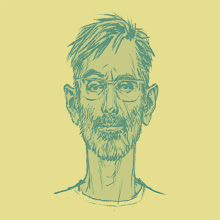
Weekly sketch

Here again I post some evidence of earnestness in keeping up a modest regimen of once-a-week drawing sessions with accomplished artist & friend
Jeff Fisher. We managed to get together Friday morning, pre-workday, for a not entirely disappointing short exercise. (Also managed to get together the week before, but I didn't get around to posting. Wasn't much to show for that session anyway.)
This week we sat outside for the first time since beginning these sessions. Can't say that we seemed to derive much inspiration from the outdoor setting: Jeff took an interest, vaguely, in an overturned wheelbarrow, and I took interest in nothing around us and so, shortly, ended up just drawing Jeff – which I might as well have done inside. And as Jeff decided to move closer to his subject and I, positioned next to him, didn't bother to move as well, I ended up looking at his head from an odd angle slightly to the rear. That's apparent in the view of his ear at right here – the first thing I set to drawing, it happens.
To help myself stay loose a bit, I've started bringing along a
graphite stick to supplement the ballpoint pen & the good old .5mm mechanical pencil – all alike no-fuss media. The graphite stick represents a nod, of course, to lower-level drawing studio ways of doing things, where one's frequently being encouraged to bold, expressive, gestural moves on the paper. In class, using a short, soft, squared-off chunk of mark-making matter like a conté crayon or a graphite stick facilitates, somewhat, one's resorting to 'freedom' & expressiveness, since you just can't be terribly controlled with the things, even when your instincts to refine & to fixate on detail are screaming. Besides that, though, these sticks are convenient to slip into a pocket & bring along, and they don't break readily. Convenience, as much as their putting an alternative mode of drawing at hand, makes them (additional) instruments of choice for these sketch sessions. What I want, for the time being anyway, is not to think too much about technique or the limitations of my materials. I'm not trying to master anything, I'm just trying to get going quick and to find some kind of drawing groove, if only for a few minutes at a time. If what I'm doing stops feeling like it's working, or my subject moves his head or his paw, I don't get hung up, I start something else. I'm not
doing a drawing, I'm just drawing.
There's something of Jeff's left hand on the page, his drawing hand with its funky knuckle-torquing grip; something of his ear; and a couple of shots at his profile around the eye & nose. He made no pretense of holding position, naturally – besides alternately looking up & back down, he kept turning to talk! But that's okay for this kind of thing, as I think I've made clear. Already on the page from earlier in the week was a quickie skull study in blue ballpoint. (More on skull studies another time, maybe.)
An excerpt
More from the introductory chapter of David Hart's
The Beauty of the Infinite:
[T]he beautiful is prior to all schemes of isolable meanings: it is excess but never formlessness, a spilling over, jubilant, proclaiming glory without 'explaining' it. For just this reason it fixes reflection upon the irreducibly particular, the momentary, fragile, and fortuitous. In the beautiful, when it is liberated from the 'symbolic,' a purely serial infinity is implied – such as Hegel dreaded – and the circular infinity of synthesis and transcendental reconciliation – such as Hegel heralded – is resisted. Beauty arranges the world not according to a logical or semeiological syntaxis or hypotaxis, obedient to a rigid hierarchy of accidental and essential, form and meaning, but according to a boundless and 'superficial' parataxis, whose meaning is its ceaseless sequences of supplement, addition, variation, departure, and return: elliptical divergences, unanticipated convergences, whose effect is musical, not dialectical. In the moment of the beautiful, one need attend only to the glory that it openly proclaims, and resist the temptation to seek out some gnosis secretly imparted.
Jesus regnant
There's fascinating & highly accessible discussion happening, in the last month or so, at
De Regno Christi, a blog set up to parallel publication of a series of articles in a Reformed Presbyterian denominational mag. Contributors to the blog have been drawn together from several backgrounds, all apparently with confessionally Reformed ties of some sort but not all from the RPCNA denomination. Learned of
De Regno Christi last week via
Brian Janaszek, and today
Gregory Baus, a contributor, has mentioned the unfolding discussion as well. Caleb Stegall of the provocative
New Pantagruel and
Darryl Hart, with whose work I've had some remote acquaintance, are also contributors – special cause, as far as I'm concerned, for taking interest in the conversation.
I was encouraged to read this, from Dr Hart's
entry of a week ago – beginning with a quote from Calvin:
"We have said that we can perceive the force and usefulness of Christ's kingship only when we recognize it to be spiritual. This is clear enough from the fact that, while we must fight throughout life under the cross, our condition is harsh and wretched. What, then, would it profit us to be gathered under the reign of the Heavenly King, unless beyond this earthly life we were certain of enjoying its benefits? For this reason we ought to know that the happiness promised us in Christ does not consist in outward advantages – such as leading a joyous and peaceful life, having rich possessions, being safe from all harm, and abounding with delights such as the flesh commonly longs after. No, our happiness belongs to the heavenly life" [2.15.4]
This understanding of Christ's kingship has a twofold import. One concerns the sorts of ills our societies now face. Could those be part of the hardships we face in life whether because we as saints are at odds with the world or because to look for solutions to moral and social ills is to immanentize the eschaton. That's not to say that social conditions are of no concern. But it does mean (to me at least) that Christ is king even when pornography escalates or the Da Vinci Code rules at the box office.
The second and more significant import of this understanding of spiritual kingship is that it makes sense of the cross. The kingdom of God and the reign of Christ came through the great injustice of executing an innocent man who happened to be the very Son of God. If we have an understanding of Christ's kingship that equates it with the elimination of immorality in our societies or nations, then we have no way of making sense that Christ triumphed over sin, death and the Devil through what appeared to be the defeat of his reign. I don't see how we can separate Christ's executing the office of king from his death on the cross. In which case, the evidence that we seek for his kingship may need to be sufficiently broad to include the notion that Christ reigns and his kingdom advances even through the sinful acts of wicked men.
What it may mean that Jesus now for the ages is reigning over a world rife (within & without the various manifestations of Christianized culture & the Church itself) with every sort of thing contrary to the spirit of Christ declared in the gospel, is of course the overarching problem
De Regno Christi is concerned with. Taking discussion back to basic matter, reckoning on the singular event of Jesus's crucifixion as an immeasurable good in an otherwise unspeakable evil, as Dr Hart seems in part to aim to do here, I take as a good sign for the blog's fruitfulness.
Came across what seems to be a good sign of a slightly different kind via
Jeff Cavanaugh, also last week. Jeff, a recent Patrick Henry College grad,
indicates (without going into depth) some of his concern about recent controversy around actions of the school (news I'd become aware of, distantly, through mention by
Jeremy Abel and
Mr Baus). One of the things Jeff links to is
this admirable student address, a charge to graduates whose point I think nicely complements Dr Hart's comments above. Here, the paradox of Jesus ascendant & dominant in spite of every appearance to the contrary is brought (reversing, in a way, the movement Hart's use of the bit from Calvin follows above) down by way of the societal to the individual perspective/prospective:
Which do you want more, a perfect America or the exaltation of God? You might say this is a false dichotomy? Isn't our "leading the nation and shaping the culture" one of the primary ways by which we might exalt God?
The riches, the wisdom and the power you will attain do not exalt God. God exalts Himself. He is more permanent than nations. He is more powerful than all the governments of the earth. His wisdom is greater than wisest council, and his wealth extends beyond the whole earth.
Victory is not yours to win. It has already been achieved in the person of Jesus Christ the Son of the living God. Jesus Christ is not a concept. He is not a stamp of approval for your personal ambition and desire. Jesus Christ is a person. He is the face of God in whom all glory dwells. Whether you succeed or fail, He will be glorified, and whether America stands or falls, He will be exalted.
... Seek that place where you will find his glory thickest. That is your vocation. For some of you, you will know the Person of Jesus in prosperity, for others in poverty; for some in reputation, for others in obscurity; for some in power, for others in weakness. In all of these things, whichever you pursue remember this: victory is to know Him and be known by Him.
This – here's as good a place as any to call it to mind – is the Gospel as I for one need to hear it addressed to me again and again.
Interview
Just noticed, via
Drawn!, the site
Illustration Friday, whose purpose is to inspire creativity in (would-be?) illustrators. Haven't had time to explore it much. Looks like there may be an interesting idea or two cooking behind it.
One feature of the site that certainly has potential to be interesting is its artist interview section. I was delighted to find that the first (of a total, so far, of two) interview's subject is
Chris Sickels, the prolific fellow who operates
Red Nose Studio. His stuff has been popular with a variety of U.S. magazine art directors for a few years, from what I can tell. He's not an especially rare sighting. This reflects something more, I can't help thinking, than effective marketing, or the possible fact that the novelty hasn't quite worn off that technically distinctive & whimsical imagery. There's something about his characteristic treatment of figure & face – even where he hasn't achieved his best effects – that fits an aspect of cultural mood in some way. (If there were time, I'd be inclined to make an attempt at teasing this notion out a bit. The way we respond to human-figure depiction & stylization is undoubtedly one of the more telling things to observe about what's happening in a culture. Deserves more discussion.)
Anyway, the Illustration Friday interview with Sickels turns out not to be all that interesting, as these things go. There is, though, for pondering, this beginning of his answer to the single question about his creative process: 'I usually start with words and combinations of words.' I'd love to know more about what that 'starting with words' entails, in Sickels's thinking.
Weekly sketch
Another interruption last week, so 'weekly' continues so far to be short for 'biweekly'. But that should change soon – hoping.
Not much to show for this morning's session. Couldn't get my head altogether into it. But showing up's always better than staying home and something drawn's always better than nothing, for this exercise's purposes.
Stretched out while he was dozing at our feet,
Loki's hind leg (in between dream-twitches):

An excerpt
From David Hart's
The Beauty of the Infinite, mid-way into the introduction:
[B]eauty is a category indispensable to Christian thought; all that theology says of the triune life of God, the gratuity of creation, the incarnation of the Word, and the salvation of the world makes room for – indeed depends upon – a thought, and a narrative, of the beautiful. Hans Urs von Balthasar claims there is a "Christian principle" made manifest in Christ – inseparable from the divine "content" of his identity – which, uniquely, does not oppose form to the infinite; "This," he writes, "makes the Christian principle the superabundant and unsurpassable principle of every aesthetics; Christianity becomes the aesthetic religion par excellence." One might add that to grasp the aesthetic character of Christian thought is also to understand the irreducible historicality of the content of Christian faith: the kerygma that Christ enjoins his disciples to preach is not some timeless wisdom, an ethical or spiritual creed fortified by the edifying example of its propagator, a Wesen des Christentums, but a particular story, a particular Jew, a particular form.
(I've had
Beauty of the Infinite in the active pile since sometime late last year; but only managing to get to it very slowly, here & there. It calls for some removal from distraction, which isn't come by as often as I'd wish these days.)
Pentecost
From this morning's reading of the Gospel, from John 15 & 16, at
Emmanuel Lutheran in Catonsville:
When the Advocate comes, whom I will send to you from the Father, the Spirit of truth who comes from the Father, he will testify on my behalf.... And when he comes, he will prove the world wrong about sin and righteousness and judgment: about sin, because they do not believe in me; about righteousness, because I am going to the Father and you will see me no longer; about judgment, because the ruler of this world has been condemned.... He will not speak on his own, but will speak whatever he hears, and he will declare to you the things that are to come. He will glorify me, because he will take what is mine and declare it to you. All that the Father has is mine. (NRSV)